
Blog: Sowing Connections - Curating Community, Craft and Collaboration

By Domino Panton-Oakley
Hi everyone, my name is Domino and I’m the Programme and Gallery Manager at South Square. You might be familiar with South Square for our exhibitions, workshops and events – but one important part of our work that you might not know much about is our outreach projects.
Our Arts and Heritage Officer, Gemma, manages our outreach programmes, working with a number of community groups across Bradford to develop and show arts and heritage projects. This is in partnership and part-funded by Bradford Arts Centre (formerly Kala Sangam) and is designed to connect more people to creative activities and provide a space to celebrate their heritage and identity.
It’s within this wider context that Sowing Connections came to life.
From outreach to exhibition
One of the groups that Gemma works with is the Women’s ESOL group who meet weekly at Lower Grange Community Centre. Over the past year, they’ve been working on the Rasi // Twine Together project which has seen them take part in a range of creative workshops – experimenting with textiles, collage, and sculpture, often alongside visiting artists.
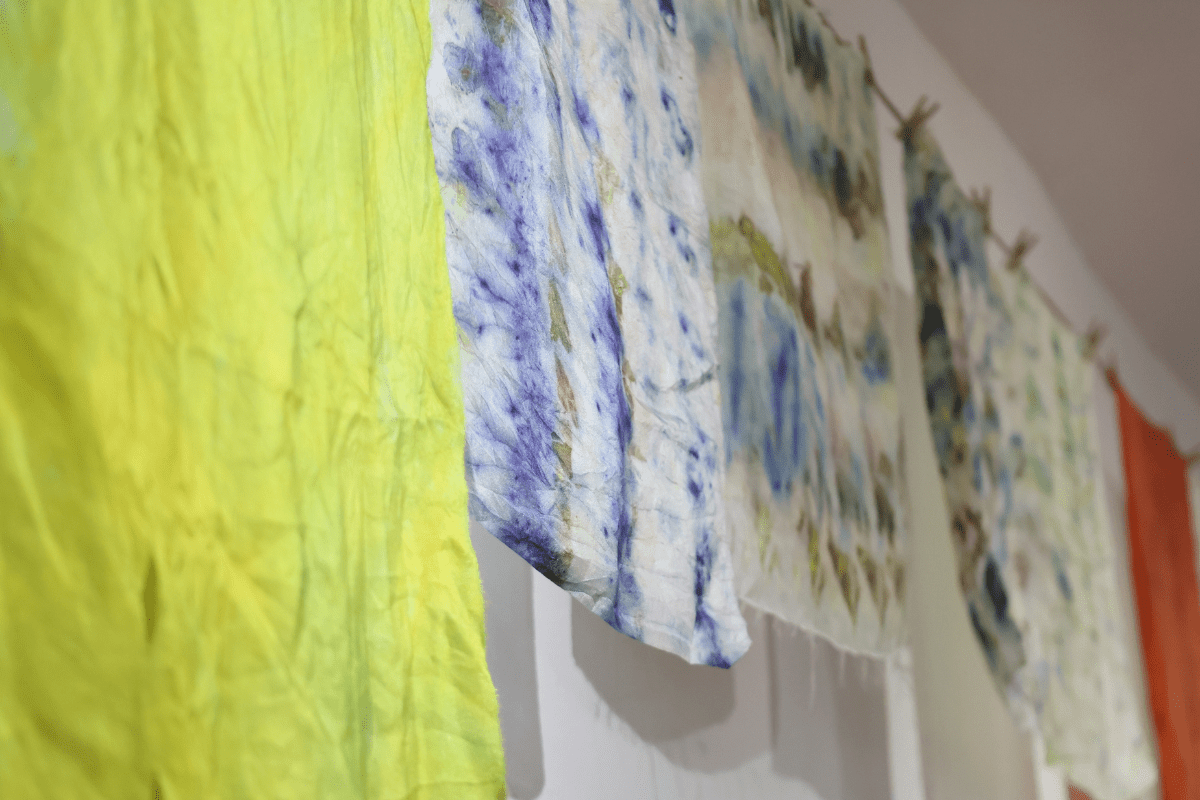
Gemma first approached me with the idea of an exhibition in Autumn 2025 and when she told me about the amazing artwork the group had created, I knew we needed to do it. Sowing Connections is a culmination of that work – a true celebration of creativity, collaboration and shared experience. The exhibition brings together pieces developed over many months, including naturally dyed fabrics, embroidered textiles, and large-scale collaborative works.
Creativity, collaboration – and chocolate
I first encountered the group on a chilly morning in October 2025. Welcomed with tea and chocolates, I joined one of their sessions to learn more about their work and discuss ideas for the exhibition.
The group spoke about growing plants in their community garden and using them to create natural dyes. These dyes were then used to colour fabrics and threads – materials that would later form many of the pieces in this exhibition. As they shared their process, I found myself already imagining how these works might be displayed and how their story could be told.
I also joined in, stitching onto Bradford wool squares that would later be dyed. My contribution is now part of the exhibition – a small but meaningful connection to the group and their process.
From that point on, the exhibition became a collaborative effort. The group worked closely with Gemma, group leader Sabiha Hussain and textile artist Claire Wellesley-Smith to decide what to include. This co-curation process ensured the exhibition truly reflected their voices and choices.
The meaning behind Sowing Connections
The group chose Sowing Connections as the name for this show which I love.
“Sowing” refers to planting seeds – something the group literally did in their garden, growing plants used in their dyeing processes. Then there’s the play on words – “sewing” reflecting the stitching and textile work central to the exhibition.
“Connections” speaks to everything else: the relationships formed within the group, links between past and present, ties to Bradford’s textile heritage and personal connections to family, culture and tradition.
Stories in stitch and cloth
Many of the works in the exhibition carry deep personal and collective significance.
The tablecloth was really one of the starting pieces of the whole exhibition, originally belonging to Sabiha’s mother. The group embroidered onto it together, sitting around a table and sharing stories of heritage, migration and Bradford’s textile history. Each person stitched from their own perspective, resulting in a piece where some elements appear sideways or upside down depending on where they were positioned around the table.
A particularly moving piece by group member, Kiran, explores mental health and spirituality. Through intricate stitching incorporating her name, Islamic poetry, and the name of Allah, she describes sewing as a meditative act – one that brought her a sense of lightness and relief. Displaying this work presented a new curatorial challenge, requiring careful consideration of how to show both its upper and lower details. After some trial and error, the final installation is hung using fishing wire allowing viewers to engage with the piece from multiple angles.
Problem-solving through collaboration
One of the most ambitious works in the exhibition is a large-scale collage inspired by mosque architecture. Created during calligraphy workshops with artist Razwan Ul-Haq, the piece combines mark-making, pattern and dyed paper into a striking, intricate composition.
When I first saw it, it was a single, four-foot square sheet made up of different pieces of paper taped together – beautiful but incredibly difficult to display without damaging. We had many conversations about how best to display this piece with budget constraints, its size and cultural considerations all added layers of complexity.
Through ongoing discussions with colleagues and collaborators, and with the help of a local joiner, we developed a bespoke solution: a sectional structure mounted on a frame that allows the piece to be displayed safely, respectfully and effectively. It was a true exercise in creative problem-solving and collaboration – and a valuable learning experience for me!
A different kind of opening
Unlike our usual busy Friday night launches, this exhibition was celebrated with a quiet gathering for the group and their families.
We set up a banquet table with flowers from the community garden, served tea and cakes and created a warm, welcoming space for reflection and celebration. Watching the group see their work displayed in the gallery – admiring, discussing, and sharing it with loved ones – was a genuinely joyful experience.
Why this exhibition matters
Sowing Connections has been a deeply rewarding project to be part of. It differs from traditional exhibitions in that it centres not on established artists, but on everyday people creating for the joy of making.
What emerges is something incredibly powerful: a space filled with care, creativity, and connection. The exhibition doesn’t just display objects – it tells stories, builds bridges, and celebrates community. And above all, it brings a real sense of joy into the gallery.


